

JPEG AI Image Compression Visual Artifacts Dataset
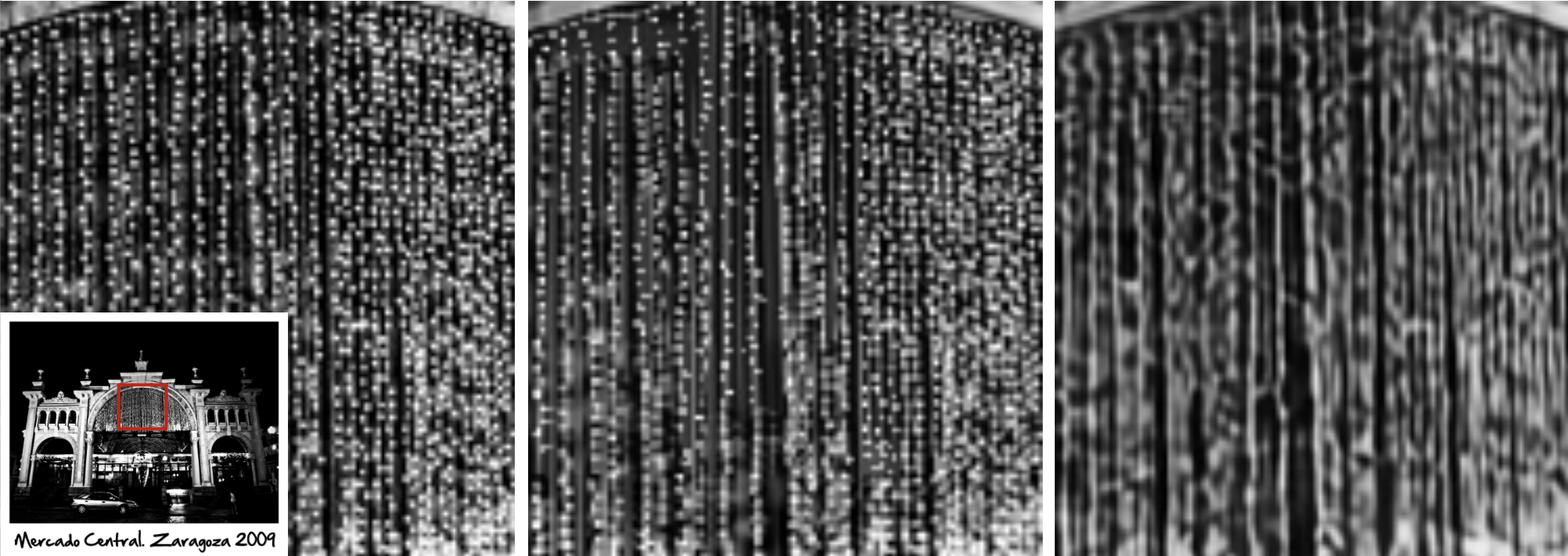
208 times smaller
tools on, hop,
204 times smaller
Key features
- 50,370 confirmed visual artifacts
- 3 artifact types: texture/boundary degradation, color distortion, text corruption
- 6 neural codecs (JPEG AI + 5 modern learned codecs)
- 350,000 source images processed
- Localized, axis-aligned bounding-box annotations
- Crowdsourced subjective validation (15 assessors per artifact)
- Includes original, neural-compressed, and traditional-compressed images
Artifact distribution
| Artifact type | Confirmed artifacts |
|---|---|
| Texture / boundary degradation | 13,581 |
| Color distortion | 8,495 |
| Text corruption | 28,294 |
| Total | 50,370 |
Note
This page provides access to the public part of the dataset (≈ 2/3 of all samples).
The remaining part is kept hidden and used exclusively for internal benchmarking and future evaluation of artifact-detection methods.
This split prevents overfitting of learning-based approaches and enables fair comparison of future methods on unseen data.
Downloads
Dataset
For any questions, please contact us via e-mail:
jai-artifacts@videoprocessing.ai
Methodology
The dataset was created to study visual artifacts introduced by learning-based image compression, with a primary focus on JPEG AI.
We processed approximately 350,000 images from the Open Images [1] dataset using JPEG AI. To verify that the proposed artifact-detection methods generalize beyond JPEG AI, we selected 3,000 source images and recompressed them using five additional modern neural codecs: Cheng 2020 (attention), EVC, ELIC, STF, and QRes-VAE.
For comparison, each image was also compressed using a traditional codec (HM-18.0) at a matched bitrate.
We then applied our own artifact-detection methods, described in detail in the paper, to identify and localize three common artifact types in neural image compression:
- texture / boundary degradation,
- color distortions,
- text corruption.
For each method, the output is a localized artifact instance, including:
- an artifact strength score (method-specific metric value)
- an axis-aligned bounding box of the affected region
We consider candidate regions where the neural-compressed image is more distorted than the traditional-compressed image at the same bitrate.
Subjective Validation
All artifact candidates were validated via crowdsourced subjective assessment using two platforms: Toloka and Yandex Tasks.
Each artifact was evaluated by 15 independent participants, and at least 12 positive votes were required to confirm its presence.
Separate validation protocols were used for each artifact type, with dedicated training and verification stages to ensure annotation quality.
Only artifacts that passed subjective validation are included in the dataset.
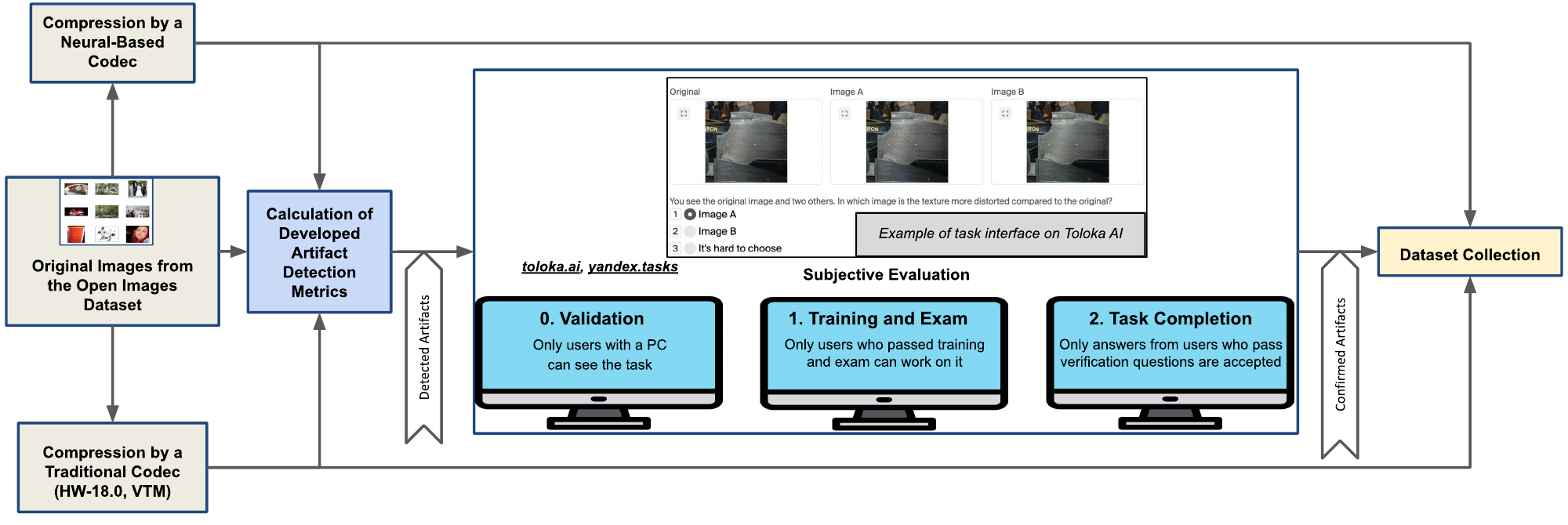
Overview of the dataset pipeline. Original images are compressed by neural and traditional codecs; our metrics detect candidate artifacts; candidates then undergo multi-stage crowdsourced validation (training, exam, verification questions), and only confirmed items are included in the final dataset.
Dataset Diversity
We analyze the diversity of the dataset using two aggregate measures: Range and Uniformity. The results demonstrate that the created dataset exhibits a high level of variability across diversity metrics, indicating its ability to cover a wide range of image content and artifact cases. This makes the dataset particularly valuable for thorough evaluation and for the development of artifact-detection methods for neural-based image compression.

Dataset diversity analysis. Distribution of dataset characteristics by Range (horizontal axis) and Uniformity (vertical axis). Each point corresponds to a dataset/subset; each subplot shows one source-image metric (Absolute Luminance, CF, Contrast, SI, SharpnessScore). Kodak, MSU LIC Benchmark, and SCLIC [2] are external reference benchmarks; the remaining points correspond to our subsets.
Annotation Format
Each dataset sample corresponds to a single artifact instance.
For every artifact we provide:
- the original image;
- the image compressed by a neural codec (with codec settings and bitrate);
- the image compressed by a traditional codec at a matched bitrate;
- the artifact type;
- a method-specific metric value;
- an axis-aligned bounding box in original-image coordinates;
- subjective voting results.
Citation
@article{tsereh2026jpegai,
  author={Tsereh, Daria and Kovalev, Egor and Rylov, Vitaly and Mirgaleev, Mark and Molodetskikh, Ivan and Kazantsev, Roman and Antsiferova, Anastasia and Vatolin, Dmitriy},
  title={JPEG AI Image Compression Visual Artifacts: Detection Methods and Dataset},
  journal={Multimedia Systems},
  volume={32},
  number={8},
  pages={528},
  year={2026},
  doi={10.1007/s00530-026-02587-1},
  url={https://doi.org/10.1007/s00530-026-02587-1}
}
Reference
-
Kuznetsova, A., Rom, H., Alldrin, N., et al.: The Open Images Dataset V4. https://storage.googleapis.com/openimages/web/index.html
-
Hofer, N., Böhme, R.: Challenging cases of neural image compression: A dataset of visually compelling yet semantically incorrect reconstructions. In: Proceedings of the 33rd ACM International Conference on Multimedia, pp. 13318–13324 (2025)
-
MSU Benchmark Collection
- Super-Resolution Quality Metrics Benchmark
- Video Colorization Benchmark
- Video Saliency Prediction Benchmark
- LEHA-CVQAD Video Quality Metrics Benchmark
- Learning-Based Image Compression Benchmark
- Super-Resolution for Video Compression Benchmark
- Defenses for Image Quality Metrics Benchmark
- Deinterlacer Benchmark
- Metrics Robustness Benchmark
- Video Upscalers Benchmark
- Video Deblurring Benchmark
- Video Frame Interpolation Benchmark
- HDR Video Reconstruction Benchmark
- No-Reference Video Quality Metrics Benchmark
- Full-Reference Video Quality Metrics Benchmark
- Video Alignment and Retrieval Benchmark
- Mobile Video Codecs Benchmark
- Video Super-Resolution Benchmark
- Shot Boundary Detection Benchmark
- The VideoMatting Project
- Video Completion
- Codecs Comparisons & Optimization
- VQMT
- MSU Datasets Collection
- Metrics Research
- Video Quality Measurement Tool 3D
- Video Filters
- Other Projects